9 novembre 2026
Hilde Blomme, Deputy CEO Accountancy Europe
Background and developments
The accountancy profession has traditionally been characterised by partnership structures, professional ownership and organic growth. Firms have expanded through internal development, long-term client relationships and reputational strength, rather than external investment or acquisitions.
However, fast-moving technological developments, digitalisation and increasing competition have led firms to invest more heavily to remain competitive. At the same time, third-party investors, particularly Private Equity (PE) funds, have identified opportunities in the sector, attracted by its recurring revenues, stable cash flows, high client retention and growth potential.
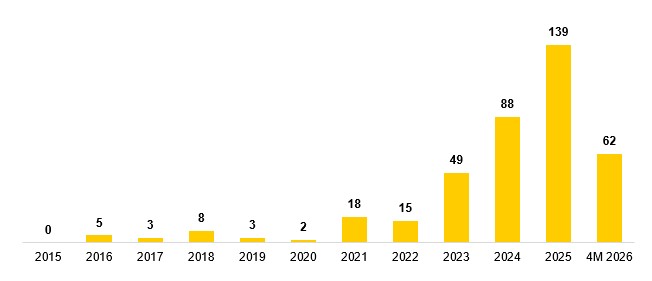
Accountancy Europe's research highlights the significant increase in PE investment in the European accountancy sector over the past decade. From 2015 to 2020, annual transaction volumes generally were less than 10. Activity accelerated considerably from 2023 onwards.
Only audit firms
Around 60% of transactions involve primarily local accounting, tax and advisory firms, while approximately 40% involve firms also providing audit and assurance services. In 2025, 139 transactions involved audit firms, representing 36% of all identified transactions. During the first four months of 2026, 62 audit-related transactions were identified, an increase of more than 33% compared with the same period in 2025.
Only 15% of all transactions are firms that have public interest entity (PIE) audits.
Belgium has experienced a particularly sharp increase in PE activity in the accountancy sector. The number of identified transactions rose from just 6 over the period 2021–2023 combined, to 8 in 2024 and 38 in 2025 (accountancy and audit firms). Two notable examples of investor-backed consolidation in Belgium are PIA Group, supported by Baltisse since 2019, and Moore Belgium, backed by Waterland.
Another development in Belgium in 2025 was the integration of Grant Thornton Belgium into Grant Thornton Advisors led by US-based New Mountain Capital, following an internationally integrated consolidation strategy.
How are PE-backed firms structured?
PE fund ordinarily invests in an accountancy and audit business that undergoes legal restructuring into two distinct entities: an audit firm and a non-audit firm. The non-audit firm usually provides professional services and resources to the audit firm through an Administrative Services Agreement (ASA).
PE structures often include holding companies, with arrangements varying depending on the level of investment. Where PE ownership exceeds 50% [1], the statutory audit firm must remain outside the PE-controlled structure to comply with the requirement for auditor control.
ASAs allow non-audit entities to provide centralised support services while maintaining a legal separation of audit activities. However, questions remain about whether these arrangements always provide sufficient safeguards for independence and effective professional control. Independence requirements under the IESBA International Code of Ethics also apply to relevant entities within the same network.
Why are investors and accountancy firms engaging with each other?
Third-party investors are attracted to the accountancy sector by:
- High client retention and stable, predictable cash flows.
- Market fragmentation and opportunities for a buy-and-build approach.
- Strong growth potential.
- The reputation of the accountancy and audit sector.
From the firms' perspective, external investment offers:
- Access to capital for expansion, technology investments and acquisitions.
- Operational expertise, professionalised management and performance monitoring.
- Solutions for succession planning, partner retirements and ownership transitions.
Risks and opportunities
Key risks
- Regulators such as the UK Financial Reporting Council (FRC) and the Dutch Authority for the Financial Markets (AFM) have called for engagement before PE transactions to safeguard independence and audit quality.
- Short-term pressures from PE ownership may undermine the adherence to technical standards, independence, and long-term focus required to sustain high-quality audit and accountancy services.
- Ethical issues, particularly around conflicts of interest, remain central. Third party investors’ financial motivations may not always align with the audit profession’s public-interest mandate.
- Cultural differences between investors and professional firms can also create friction, with tensions between growth-driven, short-term objectives and the profession’s long-term commitment to integrity and quality.
- Firms need expert legal, governance, and transaction support to structure third-party investment agreements that safeguard regulatory compliance, independence, and future stability.
- PE-backed firms may shift focus toward more profitable non-Public Interest Entity (PIE) work, potentially reducing audit capacity in key market segments and creating imbalances that could prompt regulatory action.
- The exit strategies of investors, particularly PE, typically within three to seven years, can create uncertainty over future ownership, continuity, and independence.
Key opportunities
- External capital enables investment in artificial intelligence, automation and data analytics.
- Consolidating and integrating smaller firms can create stronger networks, economies of scale and access to specialised expertise.
- Investment can support structured development programmes, professional HR functions and employee ownership schemes.
- Investor backing can strengthen credibility and facilitate expansion into new markets.
- Investors can provide access to new clients, partnerships and innovation opportunities.
Outlook
Accountancy Europe does not advocate for or against PE ownership. Its objective is to promote informed and constructive dialogue between policymakers, regulators, investors and the profession, grounded in evidence and transparency. The profession must ensure that independence, quality and public trust remain central as ownership models continue to evolve.
[1] The EU Statutory Audit Directive (2006/43/EC), as amended by Directive 2014/56/EU, requires that a majority of voting rights in statutory audit firms be held by approved statutory auditors or audit firms, subject to applicable national requirements.